Symposium · For iPhone

Argue with history’s great minds.

Bring a question from your life. Six great thinkers answer through their own method, cite real public-domain passages, and push back when your argument falls short—so you leave thinking more clearly.

Free to start. Symposium Pro unlocks more.

Every thinker is an AI interpretation grounded in public-domain translations of their writings—not the real person, and never invented quotes.

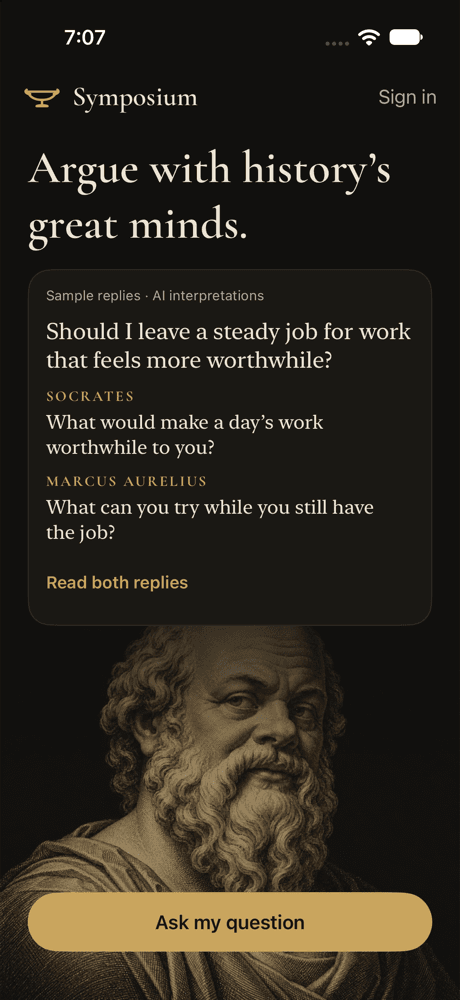
Symposium iPhone welcome screen showing Socrates, the gold kylix mark, and sample replies from Socrates and Marcus Aurelius

I · A Well-Made Book

A conversation set like a printed dialogue.

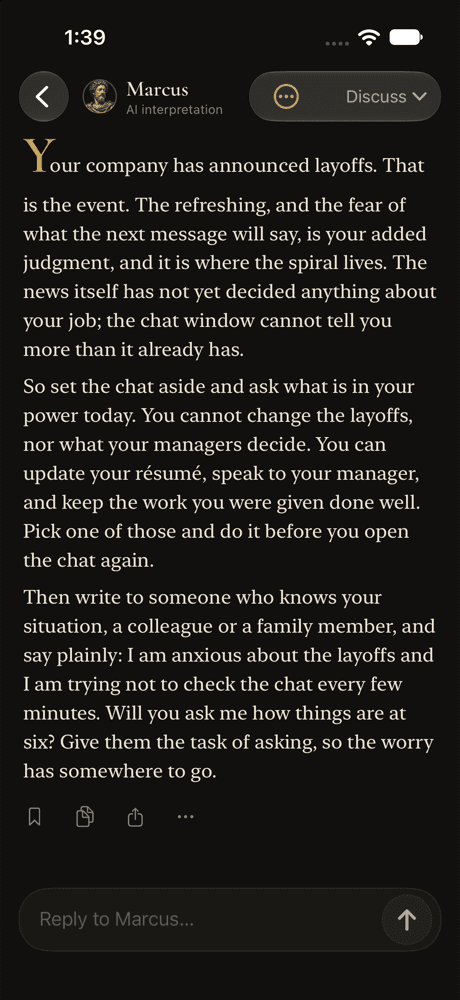
No chat bubbles. No generic assistant in a toga. Each thinker speaks in book type, reasons from their own method, and anchors claims in real passages you can open on the spot.

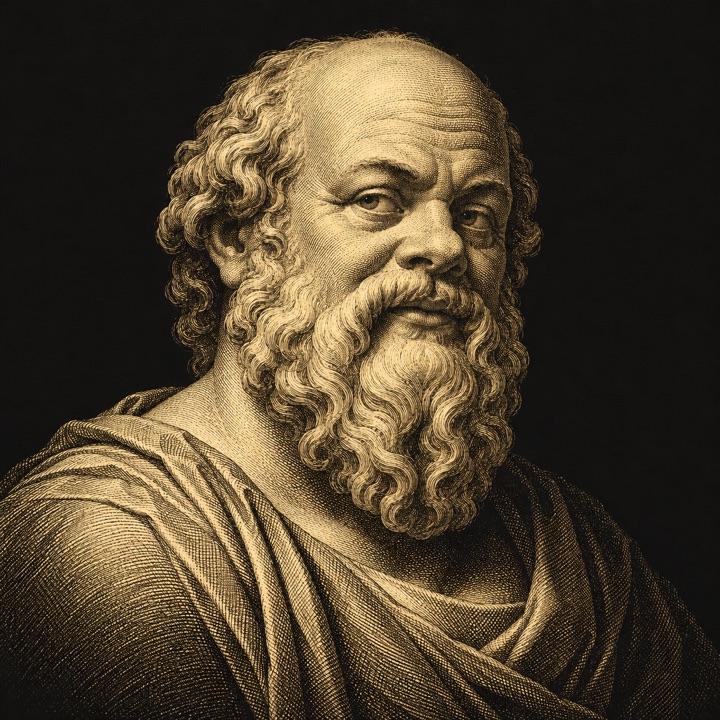
Engraved portrait of Socrates

Socrates

Sample reply · AI interpretation grounded in their writings

Discuss

You

Should I leave a steady job for work that feels more worthwhile?

Socrates

What would make a day’s work worthwhile to you? A cobbler judges a shoe by how well it carries someone down the road. Could we judge the two jobs in the same way? Tell me what you want your work to do for your life, and we can ask whether either job would do it.


II · How It Works

Ask, examine, and leave with something you can keep.

Each session moves deliberately from a real question in your life to a sharper, better-tested view of your own.

Symposium dark mode conversation showing Marcus Aurelius responding in a book serif face with a gold drop cap

1:1 Discuss · Marcus Aurelius


III · The Six Thinkers

Each mind is a method, not a costume.

Ask the same question to two thinkers and you get structurally different conversations. Select any engraving to examine how they reason, the public-domain texts behind them, and what this AI can’t know.

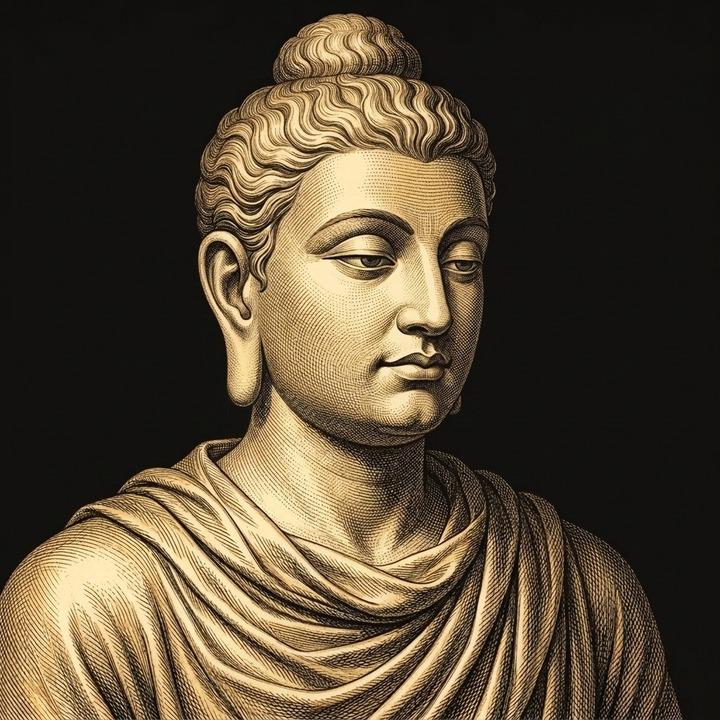
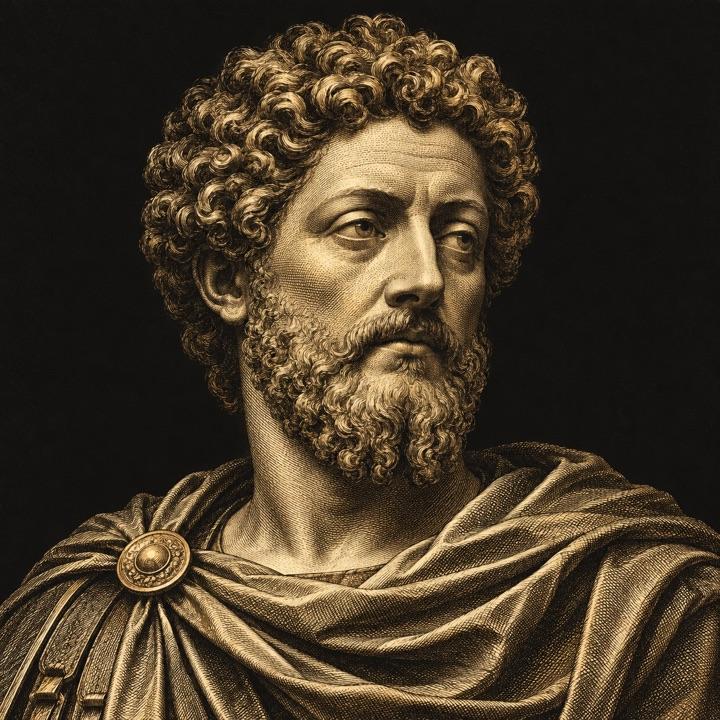
All six launch thinkers are open to try on the free plan. Copperplate portraits are original house-style engravings.

Engraved portrait of Socrates

Athens · c. 470–399 BCE

Socrates

Philosopher of the marketplace

Grounded in Plato’s early dialogues (tr. Benjamin Jowett, 1871) and Xenophon’s Memorabilia (tr. H. G. Dakyns, 1897).

How they reason

He rarely hands out answers. He asks what your words mean, tests your answer against your other beliefs, and keeps going until the contradiction, or the real question, shows itself.

Core ideas

  • The examined life
  • Knowing that you don’t know
  • Virtue as a kind of knowledge
  • Care for the soul before wealth and reputation
  • Never return wrong for wrong
Apology 38a · Plato, Apology (tr. Benjamin Jowett, 1871)
“…daily to discourse about virtue, and of those other things about which you hear me examining myself and others, is the greatest good of man, and that the unexamined life is not worth living.”

What this AI can’t know: Socrates wrote nothing; we know him through Plato and Xenophon, who don’t always agree. Anything about today’s world is our interpretation of his method.


IV · The Council

Put one question to three minds—and watch them disagree.

Convene two or three thinkers around a single dilemma. Each answers in turn, cites their own sources, and ends with a plain map of where they agree, where they diverge, and the premise that separates them.

Sample Council · 3 AI interpretations

“Should I forgive a friend who broke my trust?”

You and this person are friends. A friend owes honest correction, and the other owes a fair hearing. Tell him what happened and give him room to answer. If he makes it right, give that act its weight. If he refuses, keep the distance his conduct makes necessary.

“What do you say concerning the principle that injury should be recompensed with kindness? The Master said, ‘With what then will you recompense kindness? Recompense injury with justice, and recompense kindness with kindness.’”

Confucius, Analects · tr. James Legge, 1861
The broken promise has happened; it belongs to what is outside your power. What pains you now is the judgment you keep renewing against him. You need not restore full trust to lay down anger—attend to your own steadiness, and judge clearly what to share next.

Anger returns whenever the old breach comes back to mind. Beneath it is the wish that the past had given you a different ending. Speak plainly if speaking will help, but first notice any wish to make him suffer in return, so that wish does not choose your words.

Council Synthesis

Bounded rounds · Address any thinker by name to follow up

They agree

Confucius, Marcus Aurelius, and the Buddha all suggest that forgiveness can be separated from trust, and that you can let go of anger while still choosing carefully what you share with your friend.

They differ

Confucius looks to the friend’s changed conduct over time and asks that he make the wrong right, while Marcus Aurelius focuses on your own judgments and the Buddha on releasing the wish that the betrayal had never happened.

The premise they disagree on

Whether forgiveness depends on the wrongdoer’s repair and changed behavior, or on the injured person’s inner release from the pain of the past.


V · Crafted For Depth

Built for real argument, daily reflection, and honest sources.

Discuss & Challenge

Thinkers who hold their ground.

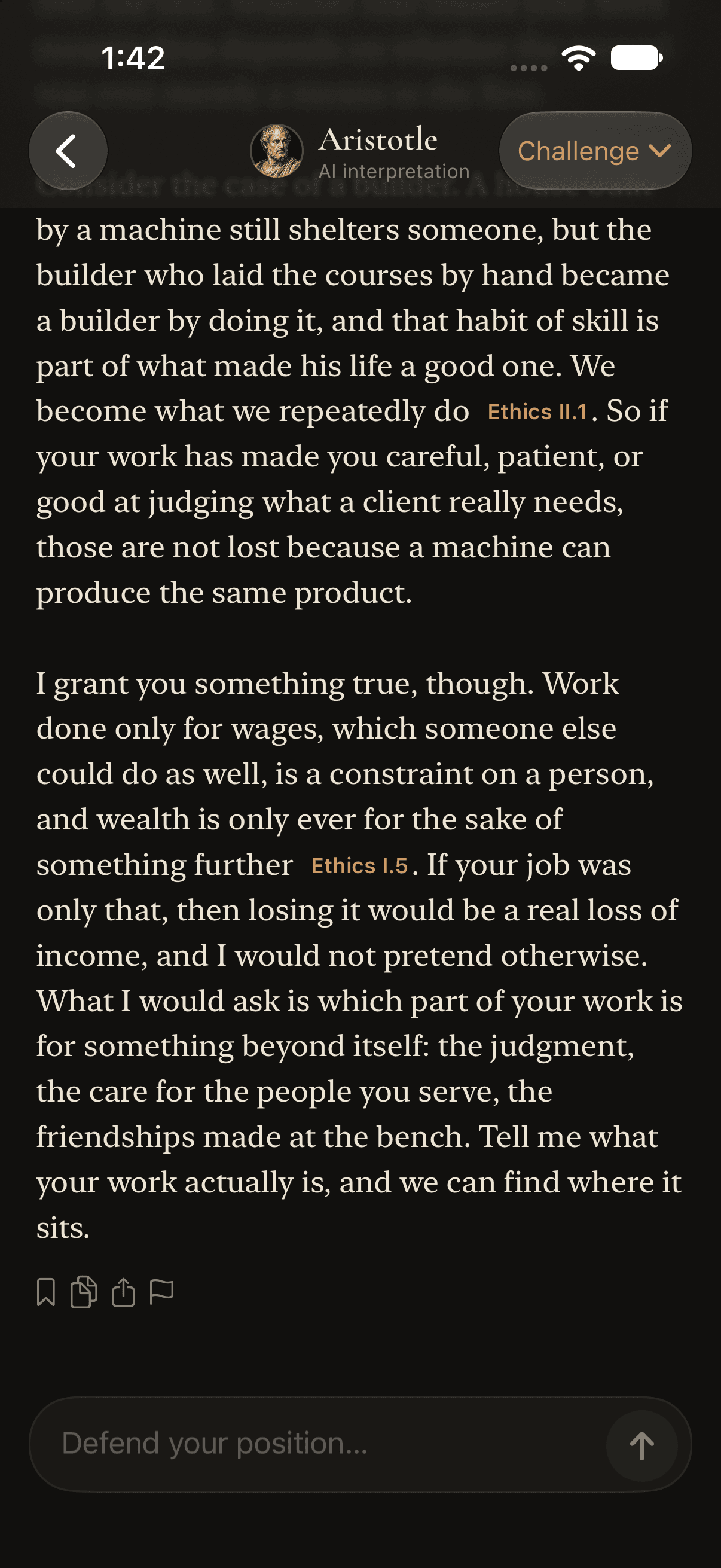
Most chatbots fold the moment you push back. Switch to Challenge mode, state what you believe, and let a thinker press on your weakest premise—conceding a point only when your argument earns it.

Challenging your position

Aristotle names where your claim holds, grants valid points explicitly, and keeps pressing on what remains untested.

Symposium Challenge mode conversation with Aristotle
Where You Stand & Notebook

Thinking that accumulates instead of evaporating.

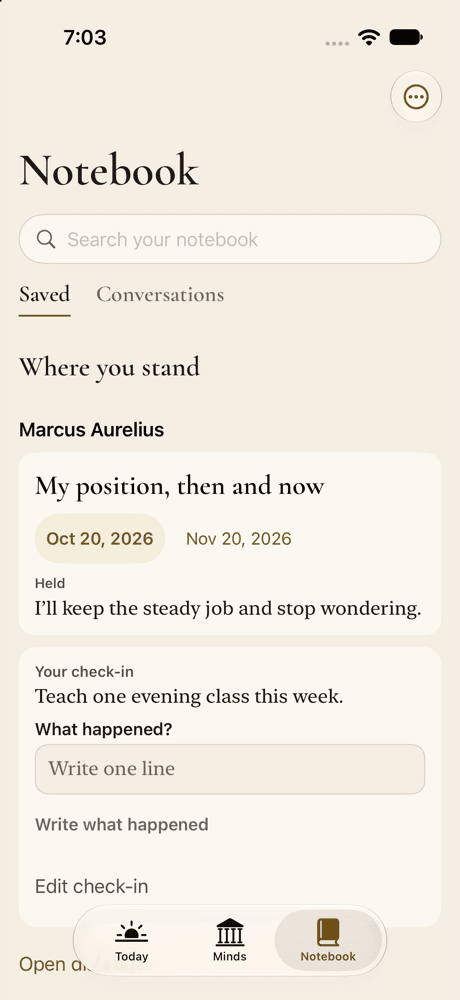
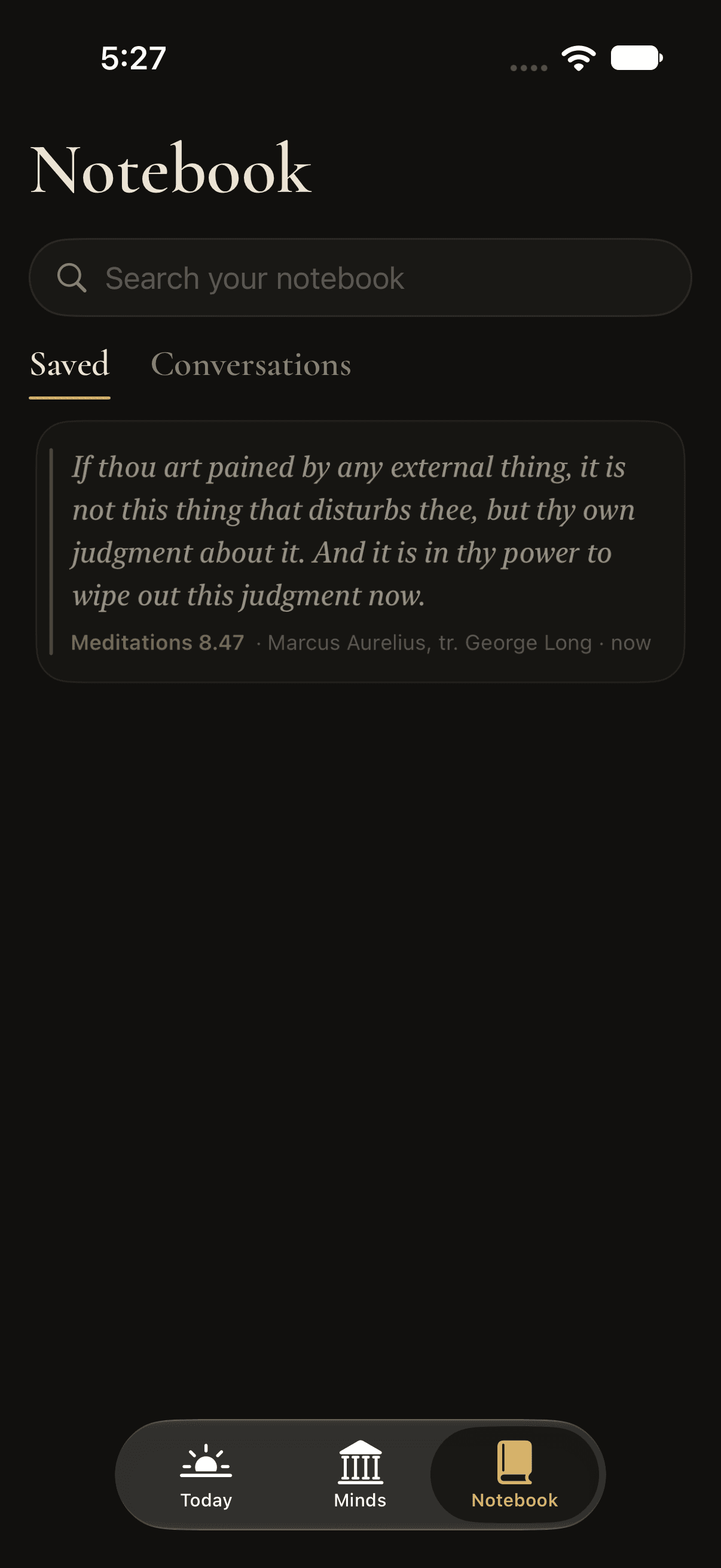
Save any striking line, verified passage, or Where you stand reflection into a searchable Notebook. Track how your position changes over time, add margin notes, or export your Notebook as a printable booklet.

Saved passages

Keep primary-source quotes alongside your own margin notes.

Where you stand

Your refined position, strongest objection, and next open question.

Symposium dark mode Notebook showing a saved Meditations 8.47 passage with the Today, Minds, and Notebook tab bar
Today’s Question · Always Free
1 / 6

One honest question every morning.

Each day brings a short prompt grounded in a real passage from one thinker. Write a few lines, receive a focused response, and carry it into your day—with an optional morning reminder and home-screen widget.

Today’s Question
Confucius

Who could you make an effort to understand before asking them to understand you?

After Analects 1.16

“I will not be afflicted at men’s not knowing me; I will be afflicted that I do not know men.”

Analects I.16 · tr. James Legge, 1861 · Public domain

Symposium dark mode Today's Question response from Plato with book ornament
Verified Primary Texts

Public-domain translations. Never invented quotes.

General chatbots routinely fabricate citations that sound plausible. In Symposium, every thinker cites by verified passage ID from 13 pinned public-domain editions. Tap any citation chip to read the real passage in context, complete with translator and year.

When an ancient thinker applies an idea to modern life—jobs, software, or modern politics—they say plainly that it is an interpretation.

Pinned Library EditionsPublic domain worldwide
  • Plato — Apology, Crito, Euthyphro, Meno, Phaedo, Symposium, Republictr. Benjamin Jowett, 1871
  • Xenophon — Memorabiliatr. H. G. Dakyns, 1897
  • Aristotle — Nicomachean Ethicstr. D. P. Chase, 1847
  • Aristotle — Politicstr. William Ellis, 1776
  • Marcus Aurelius — Meditationstr. George Long, 1862
  • The Buddha — Dhammapadatr. F. Max Müller, 1881
  • Confucius — Analectstr. James Legge, 1861

VI · Privacy In Plain Words

Your thinking is yours. Plain and simple.

We collect only what is required to run Symposium—nothing to profile you, target you, or train AI models on your private reflections.

Read the full Privacy Policy

Sent only to generate replies

Your messages and recent conversation (plus thinker memory, only if you turn it on) go to third-party AI services for one purpose: writing the thinkers’ replies. You can withdraw AI consent anytime in Settings.

Never used to train models

Symposium only uses AI services whose terms keep your conversations out of model training. Technical logs never contain the content of your messages.

No email, no ads, no cross-app tracking

Sign in with Apple provides a stable anonymous user ID—we don’t store your email, ask your age or gender, collect advertising IDs, or sell personal data.

Delete anytime in Settings

Swipe to delete any conversation in Notebook, or use Settings → Delete account and data to erase your account, threads, Notebook, memory notes, and Apple sign-in token permanently.


VII · Questions

Frequently asked questions.

Are these the real historical thinkers, or AI?

Every thinker in Symposium is an AI interpretation grounded in public-domain translations of their surviving writings—never the real person. When an ancient idea is applied to modern life, the thinker says so plainly, and every profile includes a candid note on what this interpretation cannot know.

How does Symposium keep AI from inventing quotes?

Each thinker draws from a curated library of public-domain translations pinned to standard references—such as Apology 38a, Ethics II.6, or Meditations 8.47. Every citation is verified against our source library on the server before it is shown. If a citation cannot be matched to a real passage, it is stripped out. Tapping any citation opens the actual passage with its translator and year.

How much does Symposium cost?

Free to start. Symposium Pro unlocks more. Everyone can talk with all six thinkers, finish a full first conversation, get a few replies every day, answer Today’s Question, try a Council and a Where you stand reflection, and keep a searchable Notebook. Symposium Pro brings many more replies a day under fair use, with the Council and Where you stand whenever you want them. Your Notebook, past conversations and Today’s Question always stay free. There is no free trial, and App Store prices for your country are shown before you buy.

Is Symposium therapy, or medical, legal, or financial advice?

No. Symposium is a tool for thinking and argument—not therapy, crisis counseling, or medical, legal, financial, or psychological advice. If you are in crisis or danger, the thinkers step out of character and point you toward real human support.

How is my privacy handled?

You sign in with Apple, which gives us only an anonymous user identifier—we never store your email, ask your age or gender, or track you across apps. To write replies, your messages and recent conversation are sent to third-party AI services, and Symposium only uses services whose terms keep your conversations out of model training. Thinker memory is optional and off by default. You can delete individual conversations or your entire account and server data anytime in Settings.

Which devices does Symposium support?

Symposium is built natively for iPhone running iOS 26 or later, with full Dynamic Type, VoiceOver support, dark charcoal and light parchment themes, and a home-screen widget for Today’s Question.


Bring the question you’ve been putting off.

Six thinkers, verified public-domain sources, and a quiet room to work out where you stand.

Free to start. Symposium Pro unlocks more.

AI interpretations grounded in each thinker’s writings. Not the real people, and not medical, legal, financial, or psychological advice.

Symposium

Argue with history’s great minds about the questions in your life, and leave thinking more clearly.

Thinkers in Symposium are AI interpretations grounded in public-domain translations of their writings—not the real people, and never invented quotes. Not medical, legal, financial, or psychological advice.

© 2026 Edglance LLC. All rights reserved.

Free to start. Symposium Pro unlocks more. · support@edglance.com